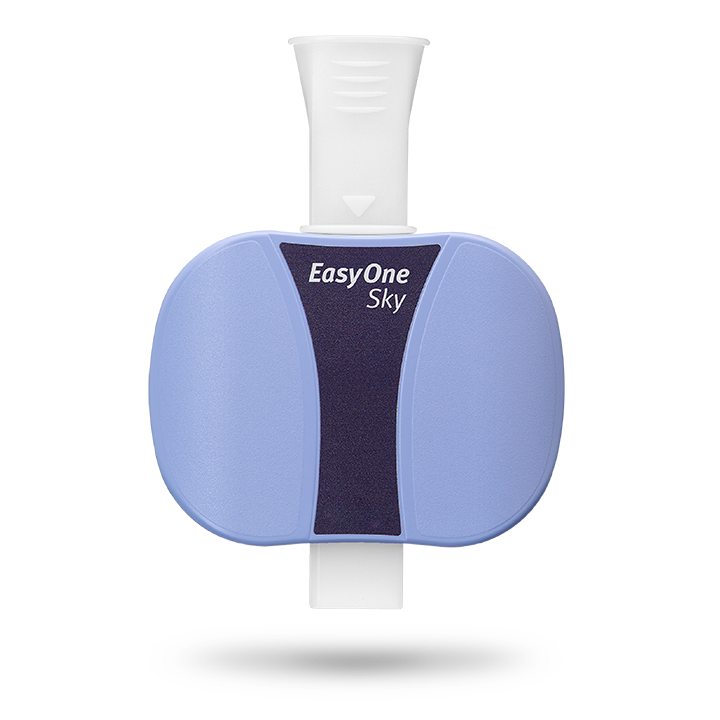
The EasyOne Sky transforms respiratory diagnosis and management with a fully connected spirometry solution.
Guided by Buddy, ndd’s built-in spirometry coach, patients can perform tests more easily while providers achieve consistent, high-quality results. With secure cloud infrastructure protecting every test and real-time insights that give healthcare systems visibility into testing performance across their network, our ecosystem supports you from deployment to diagnosis, helping teams deliver better care with confidence.
Simplified high-quality spirometry with Buddy
Buddy, your built-in spirometry coach, guides patients through each maneuver and provides real-time feedback to help achieve high-quality test results.nddHub - Advancing respiratory care through connected data
Powered by nddCloud, nddHub is a web-based portal that provides centralized fleet and performance management across your entire network.HITRUST-certified, secure data with nddCloud
HITRUST-certified infrastructure automatically backs up and protects every test while enabling secure access anywhere.Training that goes beyond go live
Training and continuous education with nddAcademy keep clinical teams confident and testing consistent over time.


nddHub – A web-based portal for real-time insights into testing performance
Using nddCloud, nddHub provides centralized fleet management to help you run more efficient, high-performing clinics across your entire network. Monitor performance trends in real time and address issues early, before they impact patient care.
- Track test frequency and volumes in real time
- Visibility into user activity and clinic-level performance
- Oversight across all your network sites
- Analyze tests, organize users, assign patients, and monitor device status and activity
- Alerts when testing stops or quality declines (coming soon!)
Meet Buddy, Your Spirometry Coach.
Proper coaching is an important part of spirometry. It helps to ensure accurate results, allowing your clinical team to diagnose and manage respiratory conditions effectively.
Effective coaching can minimize the patient’s anxiety and nervousness, leading to more reliable test results.1 It also helps to streamline the testing process, reducing the workload for healthcare staff. That’s where Buddy comes in.
Buddy helps you to …
- demonstrate how to do a great test
- coach patients
- give immediate feedback
- obtain reliable and high-quality spirometry test results
Johnson, B., Steenbruggen, I., Graham, B. L., & Coleman, C. (2021, February 8). Improving spirometry testing by understanding patient preferences. ERJ open research. https://www.ncbi.nlm.nih.gov/pmc/articles/PMC7869590/ ↩︎
Training that goes beyond go live
EasyOne Sky combines hands-on onboarding with ongoing education to ensure long-term confidence and consistency.
- Clinician-led training, onsite and/or virtual
- Frequent educational webinars
- Continuous learning to support staff turnover utilizing nddAcademy
- Confidence that grows with your team

Easy deployment across any care setting
Whether you’re an Integrated Delivery Network (IDN), primary care network, or rural health system, EasyOne Sky is designed for fast, consistent rollout without adding complexity. ndd helps align people, processes, and technology to ensure smooth adoption and measurable impact across your organization. You’re supported in every step of the way.
- Standardized device setup across all locations
- EMR support for streamlined workflows
- Consistent, accurate results from day one
- Reduced operational burden on clinic staff

nddCloud: HITRUST-certified, secure data
nddCloud continuously monitors and securely backs up your data, ensuring every test is protected and accessible at all times. Built on HITRUST-certified infrastructure, your data remains compliant, reliable, and standardized across your network.
- Automatic cloud backup for every test
- Continuous data monitoring by ndd
- HITRUST-certified security standards
- Authorized provider access from any location
- Consistent, reliable data across your entire network
- Connection to healthcare platforms and EHR/EMR systems

Who is Buddy?
Hi, I’m Buddy, your friendly spirometry coach! I was created to help healthcare providers make spirometry easy.
My goal is to ensure that you have all the tools and knowledge needed to obtain accurate results with every test. By offering clear instructions and helpful tips, I make the process smoother for both you and your patients.
Spirometry should be simple and easy, and I am here to help every step of the way!
Discover more on how we can help your patients achieve the best possible spirometry results in our latest blog.

EMR/EHR Integration Solutions
Seamlessly connect the EasyOne Sky into your EMR system through the nddCloud platform. The nddCloud connectivity solution is the optimal choice for healthcare practices, enabling streamlined workflows.
- Support of all major data exchange protocols including HL7 and API
- Centralized patient database
- Dedicated connectivity team for EMR projects
To learn more, visit our EMR solutions page.

EasyOne Mobile – Desktop Application
The EasyOne Mobile desktop program provides essential spirometry software capabilities, optimized for use on desktop and laptop computers. Its user-friendly interface, coupled with ndd’s cloud integration, ensures the security of your patients’ data. With the EasyOne Mobile application, you can also call on Buddy’s advice through your computer to coach patients during a spirometry test.
- Essential spirometry functionality
- User-friendly interface
- Seamless EMR integration
- Robust cybersecurity
- Centralized data access

TrueFlow – Trusted Ultrasound Technology
Stop worrying about calibration or accuracy of flow measurements. TrueFlow is the only ultrasound technology proven to be accurate for a lifetime for flow and volume measurements.
- Proven long-term stability
- Contact and resistance-free measurement
- Excellent accuracy and robustness
- Patented technology
To review case studies and additional information about our proven technology, visit our TrueFlow technology page.

Worldwide Compliance with Standards
Stay compliant with ATS/ERS standards country-specific regulations.
- Compliance with 2019 ATS/ERS and relevant ISO standards
- Registrations across the globe
- CE approval
- US FDA cleared to market
Click for a complete list of ndd certificates.

QC-Grading and Result Interpretation
Get automatic quality grading and interpretation based on ATS/ERS with the EasyOne Sky.
- Quality grades based on ATS/ERS 2019
- ATS/ERS 2022 interpretation
- GOLD 2008/Hardie

Comprehensive Reference Value Sets (%Pred, Z-score, and LLN)
The EasyOne Sky incorporates the most up-to-date reference values to ensure accurate and reliable spirometry measurements.
Supported reference values:
- GLI (Quanjer 2012)
- New! Global GLI (Bowerman 2023)
- NHANES III (Hankinson 1999)
Please consult our Application Note for more information about reference values.

Infection Control
The EasyOne Filter solution provides additional protection for those who wish to include a filter when performing tests.
- The EasyOne Filter keeps the ambient environment clean for technicians and patients.
- The ndd breathing mouthpiece protects the flow sensor from contamination.
Avoid cross-contamination and keep cleaning to an absolute minimum.
- Parts exposed to the patient’s breath are single-patient-use.
- The sensor is protected from contamination by the ndd breathing mouthpiece.
Please visit our Infection Control or the EasyOne FlowTube page for more information.

Product availability
Choose your path to better COPD management
| Packages |  EasyOne Sky Comfort Package |  EasyOne Sky Enterprise Package |
| EasyOne Sky device included | ✅ | ✅ |
| nddHub access | 🚫 | ✅ |
| nddCloud access | 5 users/device | 10 users/device |
| EMR maintenance* | ✅ | ✅ |
| nddAcademy / online training resources | 🚫 | ✅ |
50 pcs. FlowTubes annually | ✅ | ✅ |
Initial in-service | ✅ | ✅ |
* 1 per contract |
FAQs
How long does a spirometry test take?
A spirometry test typically takes 10 to 15 minutes, depending on the patient’s ability to follow instructions and complete the required breathing maneuvers. The test involves taking a deep breath and forcefully exhaling into a spirometry device multiple times to achieve accurate results.
Healthcare providers may repeat the test after administering a bronchodilator to assess lung function improvement. Proper coaching and technique are essential for reliable measurements.
Learn how to perform a spirometry test step by step.
Read the blog.
Open in new tabHow to coach a patient to perform spirometry
The typical spirometry exam is a three-phased process – each with their own coaching techniques to help patients produce an effective test.
- Phase 1
In the first phase, the goal is to instruct the patient on the proper techniques to apply their mouth to the spirometry mouthpiece. Best results are achieved when the patient takes a deep, deep breath, placing the mouthpiece between their teeth, and sealing the mouthpiece with their lips. - Phase 2
The second phase is the BLAST. This is when the patient will blow out as hard and as fast as possible. Coaching a patient in this phase is best achieved by developing a rapport with them prior to the exam, as the tester will learn which level of coaching is best for that individual patient. - Phase 3
The final phase is the remaining 5 to 6 seconds of exhalation. In this phase, you’ll quietly encourage the patient to “keep blowing” to complete the exhalation.
Open in new tab- Phase 1
What are examples of obstructive lung diseases?
A few examples of obstructive lung disease include:
- Chronic Obstructive Pulmonary Disease (COPD)
- Emphysema
- Chronic Bronchitis
- Asthma
- Bronchiectasis
Open in new tabWhat are examples of restrictive lung disease?
A restrictive lung disease is exactly that – one where a restriction occurs in the respiratory system.
A few examples of restrictive lung disease include:
- Interstitial lung diseases such as idiopathic pulmonary fibrosis
- Sarcoidosis
- Obesity
- Scoliosis
- Neuromuscular diseases such as muscular dystrophy or ALS
Open in new tabWhat are the important parameters in spirometry?
A spirometry test will produce a series of results or parameters that help medical professionals easily complete this exam. The three most important spirometry parameters are the FEV1, FVC, and FEV1/FVC ratio parameters.
A simple guide to reading spirometry results.
Get the tips from Buddy
Open in new tabWhat indictations are used for spirometry?
There are multiple patient-symptoms or medical conditions that justify the use of spirometry. A few of the most common indicators include:
- To manage asthma and COPD patients
- Evaluate shortness of breath
- Perform surveillance for occupational-related lung disease
- Evaluate former or current smokers over the age of 45 for COPD
- Classification of COPD. (COPD is an umbrella term that covers multiple respiratory diseases including chronic bronchitis, emphysema, and idiopathic pulmonary fibrosis (IPF))
- Monitor disease progression
- Measure response and progress due to treatment, medication, and respiratory therapy
- Smoking cessation
Tips from leading experts on the value of spirometry.
Watch the webinar
Open in new tabWhat is a diagnostic spirometer?
A diagnostic spirometer is a medical device that is used to measure lung function. It can be a portable or stationary spirometry device that is operated by a medical professional who is specially trained in proper testing procedures and techniques to produce a more consistent and reliable result.
ndd EasyOne spirometry solutions
Speak to a clinical specialist today!
###
Open in new tabWhat is FEV1 in spirometry and what does it tell you?
FEV stands for Forced Expiratory Volume. The FEV1 parameter equates to the volume that is exhaled after one second. It is intended to measure the severity of an obstruction – with average FEV1 results measuring two to four liters. A lower FEV1 result equates to higher obstruction.
A simple guide to reading spirometry test results.
Get the tips from Buddy
Open in new tabWhat is FVC in spirometry and what does it tell you?
FVC stands for Forced Vital Capacity. FVC determines the total exhaled volume of air. FVC tells the spirometry tester how much air volume the patient can exhale. The FVC will fall when the patient can’t inhale deeply or can’t exhale completely. The average FVC result for an elderly man is about four liters (one gallon) of air. The intent of this parameter is to detect restriction.
A simple guide to reading spirometry test results.
Get the tips from Buddy.
Open in new tabWhat is spirometry used for?
Spirometry is used to diagnose and monitor lung diseases, assess pulmonary function, and support occupational health screenings. Spirometry helps healthcare providers to:
- Diagnose respiratory conditions like COPD and asthma
- Monitor disease progression and treatment effectiveness in patients with chronic lung conditions
- Evaluate lung function in workplace health programs, particularly for individuals exposed to dust, chemicals, or other respiratory hazards
By using a diagnostic spirometer, medical professionals can detect lung diseases early, track changes over time, and ensure workplace safety.
Ready to add spirometry testing to your practice?
Discover more now.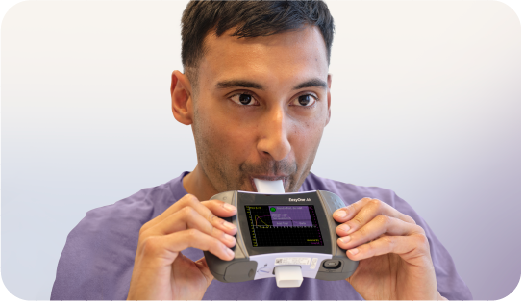
Open in new tabWhat is spirometry?
Spirometry is the primary method of assessing overall lung function. It works by measuring the volume of air that a patient can forcefully expel from the lungs after inhaling as much as possible. This non-invasive test is completed by medical professionals and is essential for diagnosing and monitoring respiratory conditions like COPD, asthma, and other lung diseases.
Using a diagnostic spirometer, a trained healthcare professional can assess lung health, detect early signs of disease, and guide treatment decisions.
Discover our advanced spirometry solutions here.
Book a demo today!
Open in new tabWhat is the difference between spirometry and a pulmonary function test (PFT)?
A spirometry test is a specific type of pulmonary function test. Spirometry measures the lungs volume (or how much) and flow (how quickly) the patient can move air into and out of their lungs. Spirometry will tell the tester if the patient has an obstruction, restriction, a mixed defect, or has normal lung flow.
Spirometry does NOT look at gas exchange and does not provide absolute lung volumes (RV, FRC, and TLC).
Diffusion capacity or transfer factor of the lung for carbon monoxide (CO) is known as a DLCO test. This measures the gas exchange and is used in conjunction with spirometry to provide a differential diagnosis. DLCO is also used to assess disease severity and is one of the best correlates of emphysema in COPD.
The final component that completes the full PFT exam is measuring absolute lung volume (RV, FRC, and TLC). This is completed by measuring body plethysmography, gas dilution, or nitrogen washout. Lung volumes are commonly used for the diagnosis of restriction. In obstructive lung disease, they are used to assess for hyperinflation. The changes in lung volumes can also be seen in a number of other clinical conditions.
Want to learn more about adding PFT and spirometry to your practice?
Get a live demo today!
Open in new tabWhat is the FEV1/FVC Ratio in spirometry and what does it tell you?
The FEV1/FVC ratio is typically expressed as a percentage (such as 75%). Nearly three-fourths of lung volume can normally be exhaled during the first second of the spirometry test. As such, the normal ratio falls between 65 to 85 percent. The range of normal FEV1/FVC ratio is determined by the patient’s age.
A simple guide to reading spirometry test results.
Get the tips from Buddy.
Open in new tab
Specifications
Standards & Recommendations
Quality, electrical, medical devicesISO 13485, ISO 14971, IEC 62366-1,
IEC 60601-1, IEC 60601-1-2, 2012/19/EU, 2011/65/EU, 2015/863, 2006/66 EU, 2018/852, 2014/53/EU,Market clearance e.g.FDA 510(k)
EU MDR 2017/745StandardsATS/ERS 2019 Spirometry StandardLanguages – User Interface
English, SpanishUsers & Patients
User groupHealthcare professionalAge range (patient)> 4 yearsTechnical Specifications
Dimensions4.3 x 3.3 x 1.3” / 111 x 84 x 33 mm
(L x H x W), 4.9 oz / 140 g (w/o battery)Device classificationType BF applied partOperating conditionsTemperature:
Rel. humidity (non-condensing):
Atmosph. pressure:
41-104 °F | 5-40 °C
15-90%
700-1060 hPa
Power source2 x AA batteries
(power consumption 0.3 W)Communication interfaceBluetooth Low Energy V5.1 and higherData managementEasyOne MobileApp compatibilityEasyOne Mobile app is compatible with Windows.Hardware Requirements for EasyOne MobileWindows SystemRecommended Requirements:
- CPU: AMD/Intel® with 4+ cores (e.g. Intel® Core™ i5-12400)
- RAM: 16+ GB
- Disk: Solid State Disk with a minimum of 10% free disk space
- Resolution: 1920 x 1080 pixel
- Color depth: 32 bit
- Broadband internet connectionTest & Parameters
TestTest descriptionAvailable ParametersFVCForced expiratory vital capacity testBEV, FEF25, FEF25-75, FEF50, FEF75, FET, FEV.75*, FEV.75/FVC*, FEV1, FEV1/FVC, FEV1Q, FVC, PEF
*only shown for children <6 yr
FVLFlow volume loop testBEV, FEF25, FEF25-75, FEF50, FEF75, FET, FEV.75*, FEV.75/FVC*, FEV1, FEV1/FVC, FEV1Q, FIVC, FVC, PEF, PIF
*only shown for children <6 yr
PostPost bronchodilator testFVC %change, FEV1 %changePredicted Normal Values – Spirometry
Global GLI (Bowerman) 2023, GLI (Quanjer) 2012, NHANES III (Hankinson) 1999System Interpretation
ERS/ATS 2022, GOLD/HardieFlow/Volume Sensor
TypeUltrasonic transit timeFlow range± 16 l/sFlow resolution1 ml/sFlow accuracy (except PEF)± 2 % or 0.020 l/sPEF accuracy± 5 % or 0.2 l/sVolume range± 12 lVoume accuracy± 2 % or 0.050 lResistance< 1.5 cm H2O/l/s at 14 l/sOrder Information Accessories*
Part numberProduct5050-50EasyOne FlowTube, individually wrapped,
box of 50 pcs5050-200EasyOne FlowTube, individually wrapped, box of 200 pcs5050-500EasyOne FlowTube, individually wrapped, box of 500 pcs2030-2ndd calibration syringe 3L with EasyOne FlowTube Cal Check Adapter5030-2EasyOne FlowTube adapter2800-50.1spEasyOne Sky Bluetooth dongle2091-422EasyOne Filter FT, box of 100 pcs*not available in all countriesOrder Information Device*
Part numberProduct9500-1EasyOne Sky Comfort Package9500-2EasyOne Sky Enterprise Package*not available in all countries