COPD through the seasons: what to know to protect your lungs year-round
Living with COPD means learning how to adapt, not just day by day, but season by season.
Changes in temperature, humidity, air quality, and seasonal allergens can affect breathing and COPD symptoms. In this blog, we’ll explore how seasonal changes impact people with COPD and share practical tips to mitigate these challenges. With the right knowledge and careful planning, those living with COPD can enjoy every season.
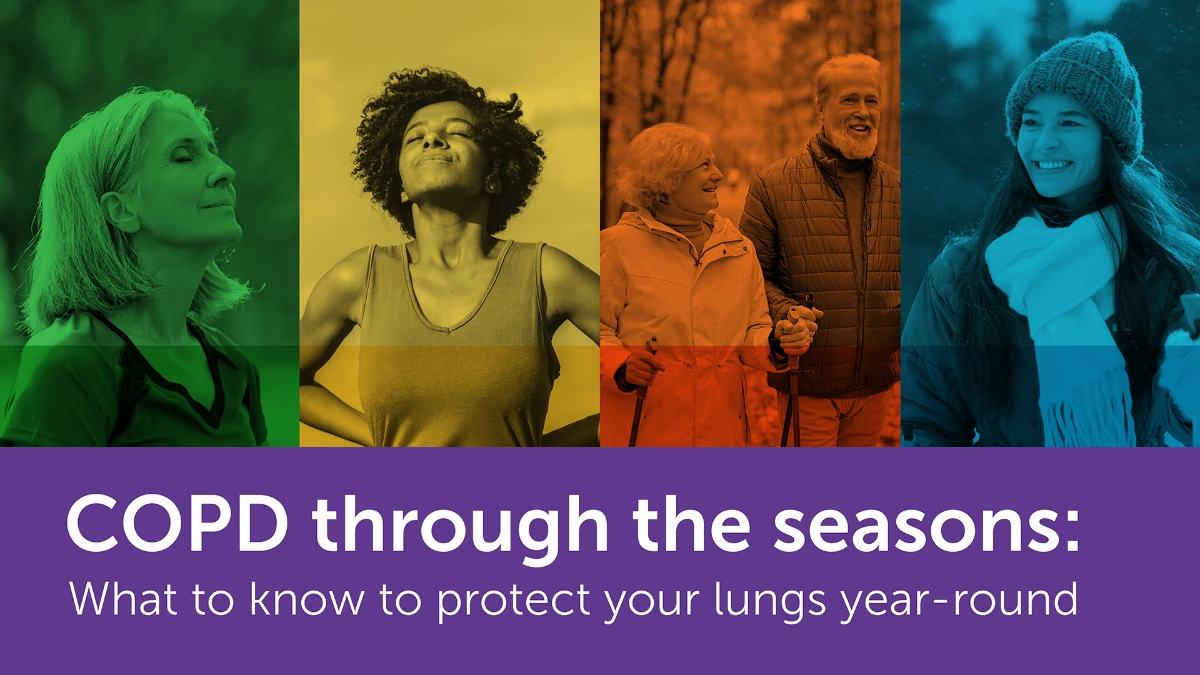
Spring and COPD: pollen, changing weather, and temperature swings #
As nature wakes up, so do allergies. Spring brings pollen, mold spores, and sudden temperature swings that can worsen breathing for people with COPD. This makes returning to outdoor activities, such as walking, gardening, socializing, or simply running errands, a bit more complicated, as there is more to consider.
Pollen is one consideration. Tree and grass pollen emerge in the spring, although grass pollen is out nearly year-round in warmer climates.1 Changing weather conditions, such as thunderstorms, may also create breathing challenges due to shifts in barometric pressure, temperature, or particulate matter.1 Another spring challenge includes temperature swings that can irritate airways.
While you can’t control the seasons, you can protect yourself. Tracking air quality and pollen forecasts on weather apps and sites like www.AirNow.gov, www.pollen.com, or the National Allergy Bureau can help you plan your days.21 When pollen is high, air quality is poor, or the temperature is hot, staying inside is the best plan. Be sure to close windows, use fans and air conditioning to keep cool, and use a HEPA air purifier.2 If you need to go out when pollen is high, wear a face mask and be sure to change clothes and shower after.2
Summer and COPD: heat, humidity, and air pollution #
The carefree days of summer aren’t so carefree when you’re living with COPD. High temperatures and humidity mean more than time at the beach or pool—they mean an increase in perceived breathing effort. The risk of dehydration also increases, making it harder to clear mucus. Additionally, summer heat brings elevated ozone levels and smog, especially in urban areas, leading to respiratory inflammation and breathing challenges.1 Grass pollen is also another trigger that can make breathing more difficult.1
So, what can you do? To combat these summer challenges, let’s focus on a few areas: monitoring air quality, staying hydrated, and prioritizing rest. Once again, checking local air quality index (AQI) reporting on weather apps, or visiting www.AirNow.gov, where you can enter your zip code, city, or state to view color-coded air quality ratings, pollutants, trends, and maps, is a great start.2 The National Allergy Bureau also has pollen counts.2
On poor air quality or hot days, staying indoors and keeping cool with fans or air conditioning is best.2 Also, using a HEPA air purifier is helpful.2 If you need to go outside when the air quality is poor, wear an N95 for protection.2 If you must go outside on hot days, limit outdoor activities to early morning and late evening.2 Finally, staying hydrated–with water, electrolyte-rich fluids, and water-based fruits and vegetables–and resting often can support healthy breathing.2
Autumn and COPD: cooler air, infections, and allergies #
Autumn marks the beginning of cooler temperatures, increased time indoors, and the influenza season. Autumn allergens such as ragweed, mold, and dust are also more prevalent due to damp weather and indoor environments.
These seasonal challenges can lead to COPD symptom flare-ups. Damp, chilly air can trigger coughing, while cold weather brings with it colds, flu, and respiratory infections that increase breathing difficulty. In fact, Hicks et al. report that approximately “50-70% of COPD exacerbations are triggered by either bacterial or viral infections that stimulate an inflammatory response.”3
To help manage these autumn challenges, here are a few healthy breathing tips. Again, visit sites like www.AirNow.gov for air quality reports or the National Allergy Bureau for pollen and mold counts.2 Arm yourself with educational knowledge about fall allergens, and stay indoors midday with the windows closed when pollen is at its peak.4 If you must be outside when pollen is high, wear a face mask, and wash your hair, body, and clothing upon returning indoors.5 Also, arrange for prompt leaf removal since mold spores hide in fallen leaves.5
For indoor protection, keep furnace filters maintained, use air conditioning when needed, and consider an air cleaner.5 Finally, get a flu shot and monitor symptom changes with the shifting weather to report back to your healthcare professional.
Winter and COPD: cold, dry air and indoor air quality #
Winter is a difficult season for people with COPD. Whether spending time outdoors, where cold air can tighten airways, or indoors, where dry air, germs, and cross-infection abound, significant challenges exist. Since viruses generally thrive in lower temperatures,6 winter is a peak time for sickness. Common winter respiratory illnesses include RSV, influenza A, and Mycoplasma pneumoniae,6 which can be dangerous for those with COPD.
Research shows that COPD exacerbation rates increase during winter. Data from the TORCH study revealed that, except in the tropics, exacerbations increased during wintertime.6 Similarly, a study in the Barcelona metropolitan area showed that as the mean weekly temperature decreased, COPD hospitalizations increased.7 Additionally, a study of climate regions in Canada and the United States found that the highest rates of COPD exacerbation occurred in winter.8 Along with cold air and illness, air pollution may be a trigger. A study of one Polish hospital showed that increased exacerbation rates in the winter correlated with higher levels of PM2.5 and PM10.9
To protect your lung health during winter, small adjustments can make a big difference. Wash your hands frequently, avoid spending time with those who are sick, and ask your medical professional if a pneumococcal vaccine is right for you.4 Also, limit time outdoors. For healthy breathing indoors, clear dust, and utilize a humidifier and air purifier
Conclusion #
Every season brings its own challenges, but also its own opportunities to take charge of your lung health. By planning ahead and listening to your body, you can better manage your COPD, no matter the weather. Remember, consistent treatment, regular checkups, and healthy daily habits make every breath count, all year long.
Hess M. Managing lung disease in the heat of summer [Internet]. 2021 Aug 9 [cited 2025 Dec 31]. Available from: https://nddmed.com/blog/2021/managing-lung-disease-in-the-heat-of-summer/ ↩︎ ↩︎ ↩︎ ↩︎ ↩︎
LaRosa T. Top 5 tips for managing lung disease during the summer months [Internet]. Updated 2025 June 13 [cited 2025 Dec 31]. Available from: https://nddmed.com/blog/2024/5-tips-for-managing-lung-disease-in-the-summer/ ↩︎ ↩︎ ↩︎ ↩︎ ↩︎ ↩︎ ↩︎ ↩︎ ↩︎ ↩︎ ↩︎
Hicks A, Healy E, Sandeman N, Feelisch M, Wilkinson T. A time for everything and everything in its time - exploring the mechanisms underlying seasonality of COPD exacerbations. Int J Chron Obstruct Pulmon Dis. [Internet]. 2018 Sep 5 [cited 2025 Dec 31]; 13:2739-2749. Available from: https://pmc.ncbi.nlm.nih.gov/articles/PMC6130531/ doi: 10.2147/COPD.S146015. PMID: 30233164; PMCID: PMC6130531. ↩︎
National Emphysema Foundation. How Seasons Affect COPD Sufferers [Internet]. Date unknown [cited 2025 Dec 31]. Available from: https://www.emphysemafoundation.org/index.php/news-and-events/events/83-copd-emphysema-articles/492-how-seasons-affect-copd-sufferers ↩︎ ↩︎
COPD Foundation. Preparing for fall [Internet]. Date unknown. [cited 2026 Jan 7]. Available from: https://www.copdfoundation.org/COPD360social/Community/COPD-Digest/Article/1241/Preparing-for-Fall.aspx ↩︎ ↩︎ ↩︎
Donaldson GC, Wedzicha JA. The causes and consequences of seasonal variation in COPD exacerbations. Int J Chron Obstruct Pulmon Dis. [Internet]. 2014 Oct 6 [cited 2025 Dec 31]; 9:1101-10. Available from: https://pmc.ncbi.nlm.nih.gov/articles/PMC4199860/ doi: 10.2147/COPD.S54475. PMID: 25336941; PMCID: PMC4199860. ↩︎ ↩︎ ↩︎
Almagro P, Hernandez C, Martinez-Cambor P, Tresserras R, Escarrabill J. Seasonality, ambient temperatures and hospitalizations for acute exacerbation of COPD: a population-based study in a metropolitan area. Int J Chron Obstruct Pulmon Dis. [Internet] 2015 May 8 [cited 2026 Jan 5];10:899-908. Available from: https://pmc.ncbi.nlm.nih.gov/articles/PMC4431472/ doi: 10.2147/COPD.S75710. PMID: 26056439; PMCID: PMC4431472. ↩︎
So JY, Zhao H, Voelker H, Reed RM, Sin D, Marchetti N, Criner GJ. Seasonal and Regional Variations in Chronic Obstructive Pulmonary Disease Exacerbation Rates in Adults without Cardiovascular Risk Factors. Ann Am Thorac Soc. [Internet] 2018 Nov [cited 2026 Jan 5];15(11):1296-1303. Available from: https://pubmed.ncbi.nlm.nih.gov/30063372/ doi: 10.1513/AnnalsATS.201801-070OC. PMID: 30063372; PMCID: PMC6322011. ↩︎
Romaszko-Wojtowicz A, Dragańska E, Doboszyńska A, Glińska-Lewczuk K. Impact of seasonal biometeorological conditions and particulate matter on asthma and COPD hospital admissions. Sci Rep. [Internet] 2025 Jan 2 [cited 2026 Jan 5];15(1):450. Available from: https://pmc.ncbi.nlm.nih.gov/articles/PMC11696462/ doi: 10.1038/s41598-024-84739-9. PMID: 39747992; PMCID: PMC11696462. ↩︎
Written by

Kelly Sicard
MA
Kelly M. Sicard is a freelance writer with an M.A. in English & Creative Writing, known for transforming complex subjects into clear, practical, and engaging content. With two decades of experience working in nonprofit and educational settings, she brings a strong foundation in communicating scientific, medical, and research-based information to diverse audiences through a human-centered approach.
Read more about Kelly Sicard