
The business case for spirometry in primary care
A practical, evidence-based look at how incorporating point-of-care spirometry in primary care clinics may improve clinical outcomes, reduce costs, generate revenue, and optimizes workflows.

Spirometry is an investment — a worthwhile one #
Around the world, millions of people live with undiagnosed pulmonary diseases and experience negative health outcomes through no fault of their own. Many of the outcomes associated with asthma and chronic obstructive pulmonary disease (COPD) are potentially preventable through early detection with the help of pulmonary function tests.
Fortunately, while pulmonary function test devices are an investment for primary care clinics, they are a worthwhile one. Let’s talk about how spirometry, often overlooked or underused, offers measurable clinical and financial returns.
Check on our PFT reimbursement calculator to assess the opportunity for your clinic!
Calculate now!
The gap in care #
An unfortunate reality is that delayed diagnoses and misdiagnoses are common and major drivers for poor long-term outcomes, including increased exacerbations, more hospitalizations, and premature mortality.
It’s also not a mystery why so many people receive late diagnoses. Most people with undiagnosed pulmonary conditions are seen by primary care physicians and general practitioners, most of whom are doing their best with limited resources. As pulmonary diseases are highly prevalent and can share similar symptoms, clinical observation alone is often relied upon, instead of with the assistance of spirometry, as is recommended by leading policy organizations. The Global Initiative for Chronic Obstructive Lung Disease (GOLD) guidelines emphasize that spirometry is mandatory to establish the diagnosis of COPD.
Recent evidence suggests that relying on clinical observation alone is insufficient, with studies indicating that between one-third and two-thirds of diagnoses made without spirometry are incorrect. 12 Misdiagnoses delay appropriate treatment regimens and lead to higher rates of emergency room visits.
Without access to spirometry in the rooms where patients are being seen, it is more difficult to make the right diagnosis.3
In addition to immediate consequences, there are long-term problems that arise from delayed diagnoses. Over time, as patients have more exacerbations and their COPD becomes even less well-controlled, they are more likely to be readmitted into the hospital just weeks after an initial admissions.4 Readmissions are extremely costly and can lead to hospitals getting financially penalized, so they should be avoided as much as possible.
EasyOne spirometry machines - tailored solutions for every practice.
Explore our spirometry machines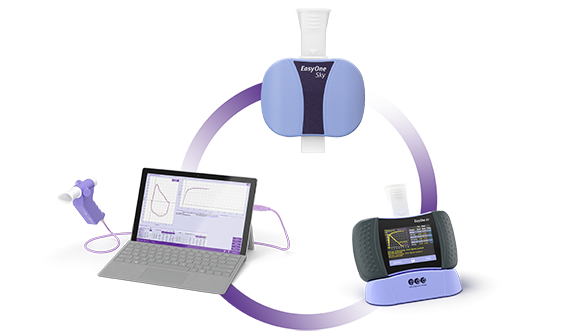
Where primary care clinics come in #
Since primary care clinics often serve as the first step in a patient’s journey, investing in a pulmonary function test device may just be one of the most tangible and important ways that clinics can improve patient outcomes and ensure financial viability and sustainability. Incorporating spirometry is a direct revenue generator for clinics, and one that enables a high return on investment by serving as a diagnostic and monitoring tool.
With access to spirometry, they can better serve their patients through screening and diagnosing people earlier in their disease journey and regular monitoring, providing the opportunity to assess how effective medications are working and making it easier to switch as needed.5 All while also generating a crucial source of revenue.
Workflow efficiency and quality you can trust #
It hasn’t always been practical for clinics to incorporate spirometry devices at point-of-care. That is no longer the case. Spirometry devices, including ndd EasyOne devices, are now far more portable, easy-to-use, consistent, and reliable.6 They can be incorporated into a clinic’s office relatively quickly without as much administrative effort and lead-time. Spirometry devices can directly integrate into electronic medical/health records, EasyOne devices do not require re-calibration, and devices can be simply incorporated into clinical workflows with minimal training, all without sacrificing precision by meeting ATS/ERS standards.
A high-value, low-barrier investment that helps people and generates revenue #
Primary care clinics have the opportunity to directly benefit patients in a significantly meaningful way while also adding a revenue source. Spirometry offers both better care and financial sustainability in primary care. Its ROI is measurable, scalable, and directly tied to quality and workflow optimizations.
Jørgensen IF, Brunak S. Time-ordered comorbidity correlations identify patients at risk of mis- and overdiagnosis. Npj Digit Med. 2021;4(1):12. doi:10.1038/s41746-021-00382-y ↩︎
Decramer M, Janssens W, Miravitlles M. Chronic obstructive pulmonary disease. Lancet Lond Engl. 2012;379(9823):1341-1351. doi:10.1016/S0140-6736(11)60968-9 ↩︎
Loui H, Bierer GB, Chima-Melton C, Aysola RS. IMPROVING SPIROMETRY RATES IN PATIENTS WITH A COPD DIAGNOSIS. CHEST. 2023;164(4):A3775. doi:10.1016/j.chest.2023.07.2455 ↩︎
Jacobs DM, Noyes K, Zhao J, et al. Early Hospital Readmissions after an Acute Exacerbation of Chronic Obstructive Pulmonary Disease in the Nationwide Readmissions Database. Ann Am Thorac Soc. 2018;15(7):837-845. doi:10.1513/AnnalsATS.201712-913OC ↩︎
Song C, Xie Y, Feng Z, Xue Z, Panagiotakos D, Hao X. Cost-effectiveness of screening for chronic obstructive pulmonary disease: a systematic review and meta-analysis. BMC Public Health. 2025;25(1):3779. doi:10.1186/s12889-025-24797-4 ↩︎
Skloot GS, Edwards NT, Enright PL. Four-year calibration stability of the EasyOne portable spirometer. Respir Care. 2010;55(7):873-877. ↩︎
Written by

Tré LaRosa
Scientist & Medical writer
Tré LaRosa is a consultant, scientist, and medical writer based in the Washington, DC area, with a strong foundation in clinical research and a particular expertise in patient reported outcomes and respiratory health communication.
Read more about Tré LaRosa